







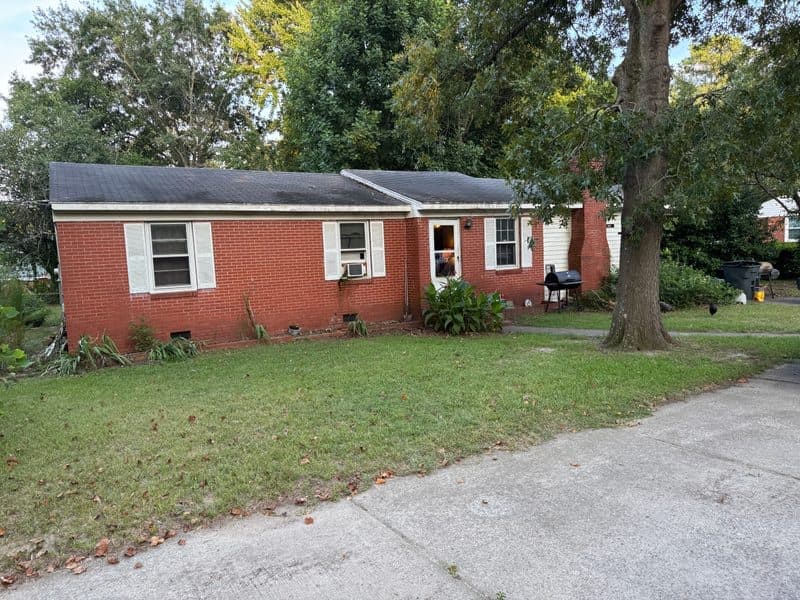
Selling a Mebane house as-is means selling it in current condition with no repair obligation on the seller, no post-inspection repair list, and no buyer-side walk-back tied to a defect that surfaces during due diligence. The structure is most useful when the property has issues that consistently kill financed deals: knob-and-tube wiring on a pre-1950 home near the historic downtown core, lead paint that triggers FHA/VA repair flags, asbestos siding common to mid-century Mebane homes, EIFS moisture intrusion on a 1995 Cates Farm or Mill Creek subdivision build, polybutylene plumbing on a 1990 Mebane property, an open code case with the City of Mebane compounding fines, decades of belongings inside an inherited home from a long-tenured original owner.
For Mebane sellers, the as-is option matters more than in younger NC submarkets because of the city’s pre-1900 historic core, pre-1950 stock along Mebane Oaks Road, and 1985-1995 polybutylene-era subdivisions concentrated on both the Alamance and Orange County sides of the line. Each era produces specific condition issues that financed buyers and their lenders catch. The page below walks through how NCGS Chapter 47E disclosure works on Mebane stock, the actual condition catalogs by era, why FHA and VA buyers can’t close on most as-is Mebane listings, and how the math compares to a pre-listing repair-and-list path.
NCGS Chapter 47E Disclosure on Pre-1978 Mebane Homes
North Carolina’s Residential Property Disclosure Act (NCGS Chapter 47E) requires sellers of residential real property to deliver a written disclosure form to buyers before contract execution. The form lists 30+ specific property characteristics (electrical, plumbing, structural, HVAC, water intrusion, environmental, legal status of the property) and the seller answers each as “Yes,” “No,” or “No Representation.”
The “No Representation” answer is the important one for as-is Mebane sellers. It’s legitimate when the seller genuinely doesn’t know the answer. Common scenarios where No Representation is the correct legal answer: inherited Mebane property where the seller never lived in the home, long-term rentals where the seller hasn’t been inside in years, properties bought as- is years ago where the seller never had original construction records. No Representation isn’t a way to hide known defects; it’s a legal acknowledgment of genuine lack of knowledge.
For pre-1978 Mebane homes (which includes most of the historic downtown core, the Mebane Oaks Road area, and a meaningful share of properties throughout older Mebane) federal lead- based paint disclosure under Title X of the Residential Lead- Based Paint Hazard Reduction Act layers on top of the state 47E form. Sellers must provide the federal lead disclosure form, the EPA’s lead pamphlet, and any known records or check “no records” if none exist. Title X compliance applies even on cash-as-is sales; we handle the federal-side documentation through closing.
Mebane has unusually old housing stock for its size, so Title X applies to a meaningful share of Mebane listings. A cash-as- is sale doesn’t exempt the seller from Title X disclosure, but it removes the financed-buyer underwriting problem that lead paint creates on FHA / VA / USDA loans.
Mebane’s Pre-1900 Historic District: As-Is Sale Considerations
Mebane’s pre-1900 housing stock concentrates near the historic downtown core and along Mebane Oaks Road. These properties carry condition characteristics that financed-buyer appraisals and inspections rarely accommodate, and they sometimes also carry historic-character considerations that affect renovation paths.
On the condition side, pre-1900 Mebane homes typically have original-construction electrical (knob-and-tube wiring), pre- modern plumbing (galvanized supply, original cast-iron drain), layered lead paint accumulated over a century, asbestos siding added in mid-century renovations, foundation settlement on rubble or early concrete-block stem walls, original-era windows that don’t meet modern energy-efficiency standards, and roofs that have been re-shingled multiple times over decades, often without proper underlayment work.
On the historic-character side, sellers occasionally face questions about whether structural changes during a future renovation would face local-board review. Cash-as-is sales don’t require those questions to be answered before closing; we handle character-and-renovation decisions post- purchase.
Pre-1900 Mebane sales work best as cash-as-is for the seller’s side because the financed-buyer pool for these properties is narrow and the cycle to actually close is long. Renovation investors and cash buyers handle these properties as a regular line of business; we close in 14 to 30 days with no repair obligation.
The Mebane Older-Home Condition Catalog (Pre-1950 Stock)
Mebane’s pre-1950 housing stock (concentrated in the historic downtown core and along Mebane Oaks Road) carries the full older-home condition catalog. Each of the items below is common, doesn’t disqualify a cash sale, but does regularly kill or stall financed deals.
Knob-and-tube electrical wiring. Common in pre-1950 Mebane homes, especially in original sections of the oldest historic-core properties. Most major homeowner insurance carriers won’t bind a policy with active K&T. Without bound coverage, the lender won’t fund the loan, and the financed sale collapses. Rewire to modern Romex runs $8,000 to $25,000 depending on home size, access, and how much plaster has to be opened. Cash buyers price the rewire into the offer.
Galvanized supply plumbing. Common in early-20th-century Mebane homes. Galvanized degrades from the inside, narrowing the pipe diameter and producing rusty water and pressure issues over decades. Repipe to PEX or copper runs $8,000 to $20,000 typical depending on layout and bath count.
Lead-based paint. Pre-1978 homes carry federal Title X disclosure obligations. Pre-1900 Mebane homes have layers accumulated over more than a century. FHA and VA inspections flag visible peeling lead paint as a required cure item; the cure runs $4,000 to $15,000 for EPA RRP-certified mitigation depending on scope. Cash buyers handle the disclosure but don’t face the cure gate.
Asbestos siding. Common on Mebane homes built between 1920 and 1960. Safe in place but spooks financed buyers and triggers inspection- driven price reductions. Removal runs $8,000 to $30,000 plus replacement-siding costs.
Foundation settlement. Many pre-1950 Mebane homes were built on rubble foundations or early concrete-block stem walls. Inspectors flag visible settlement evidence as “structural concerns: recommend further evaluation,” and that single sentence can kill a financed deal. Engineering report and remediation runs $5,000 to $35,000 typical for non-active settlement.
Original boilers and asbestos pipe insulation. Pre-1960 boilers still feed cast-iron radiators in many older Mebane properties. Working but inefficient; abatement of asbestos pipe insulation runs $3,000 to $12,000 depending on linear feet, and full HVAC replacement adds $8,000 to $20,000.
We buy in any condition. The repair work prices into our offer and we handle resolution post-closing.
The 1990s and 2000s Mebane Suburban Condition Catalog
Mebane’s newer subdivisions (Cates Farm, Mill Creek, Forest Oaks, and adjacent developments concentrated on both sides of the Alamance-Orange County line and along I-40/I-85) carry their own condition catalog tied to that era’s building practices and material choices.
EIFS (synthetic stucco) moisture intrusion. Common on 1990s Alamance and Orange County builds with full or partial stucco exteriors. Many lenders require moisture-meter inspection on EIFS homes; failed readings stop the loan outright. Remediation runs $15,000 to $80,000+ depending on extent. Cash buyers don’t run the moisture-meter gate.
Polybutylene plumbing. Gray plastic supply pipes installed approximately 1985 to 1995 in many Mebane subdivisions. Most homeowner insurance carriers won’t bind a policy on active polybutylene, which collapses financed sales. Repipe runs $4,000 to $15,000 typical.
LP and Masonite hardboard siding. Common on 1990s Cates Farm and Mill Creek-era builds. Swelling and rot at trim joints and around windows; replacement runs $8,000 to $25,000 typical for full re-side.
Builder-grade HVAC at year 18 to 22. Original HVAC on 2000s Mebane builds is now in the failure window. Replacement runs $6,000 to $14,000 typical for split- system AC plus furnace.
Crawlspace moisture and active mold. Mebane’s clay soil produces crawlspace humidity issues on many properties. Active mold flags pause financed loans. Encapsulation plus dehumidification runs $5,000 to $18,000 typical.
How Fast a Mebane As-Is Sale Actually Closes
Mebane as-is sellers usually need a clear answer on timing before condition. The straight version: same-day cash offer at first contact, written contract within 24 to 48 hours, title work running 7 to 10 business days on a clean-title Mebane property, and closing 14 to 30 days from contract on the standard path. Faster windows are possible (we’ve closed in 7 days when a hard deadline genuinely required it), slower windows are available when the seller wants more time to coordinate cleanout or relocation.
Atlantis Homebuyers, LLC has been buying houses across Alamance, Orange, and surrounding counties since 2018, BBB Accredited, family-owned by AJ and Isabel. We answer the phone, we walk the property, we send written offers same business day. No call centers, no algorithmic offer engines, no out-of-state operators handing your information off.
Tell us your timing constraint and your property situation at first contact. Call (984) 205-6984 or submit your address for a free same-day offer. We’ll come back with a written cash number same business day in most cases.
Why VA and FHA Buyers Can’t Close on As-Is Mebane Homes
Listing a Mebane property as-is theoretically allows financed buyers but practically doesn’t in many cases. The buyer’s lender controls whether the loan funds, regardless of contract as-is language between buyer and seller.
FHA and VA loans both pull from Minimum Property Requirements (MPRs) that pre-1950 Mebane stock and 1990s subdivisions regularly fail. The MPR list for FHA includes safe and functioning electrical, no peeling lead paint on pre-1978 homes, functioning hot-water and heating systems, no health- and-safety hazards from active mold or water intrusion, sound roof condition, no structural deficiency. VA adds its own review for safety and habitability. Conventional loans are more flexible but still require homeowner insurance to bind, which is where polybutylene and active K&T break the process.
The FHA appraiser flags MPR issues on the appraisal report. The buyer’s lender requires cure before funding. The seller has the option to repair (at the seller’s cost and on the buyer’s timeline), to renegotiate the price downward to fund cure, or to wait while the buyer attempts to switch loan products to something more flexible. Each path adds 30 to 60+ days to the timeline.
Cash sales remove the lender from the equation entirely. We don’t run an MPR review, we don’t need bound homeowner insurance to close, we don’t require a cure list. Condition prices into the offer up front.
City of Mebane Code Enforcement (Across Three Counties)
The City of Mebane enforces minimum housing standards through proactive inspections plus complaint-driven cases across all three sides of town: the Alamance County majority area, the Orange County share, and the small Durham County edge along the eastern growth corridor.
Common flags include peeling exterior paint, broken or missing windows, unsafe steps and railings, leaking roofs visible from the public right-of-way, accumulated debris, overgrown vegetation, structural deficiencies visible from outside, and unsecured outbuildings.
Violations get cited with a deadline. Missing the deadline produces fines that compound and attach as municipal liens recorded at the city level, separate from county tax records. A title search that only pulls county records misses City of Mebane lien activity entirely. We pull both city and county records as standard due diligence on every Mebane property, regardless of which county the parcel sits in. Open cases price into the offer; resolution becomes our responsibility post-closing.
The “We’ll Cover Repairs Later” National-Program Walk-Back
National algorithmic programs (Opendoor, Offerpad, and similar large-platform buyers) market themselves as as-is buyers in Mebane through marketing that frames the offer as “cash with no repair list.” The contract structure tells a different story.
These programs reserve the right to re-trade based on a 14-to- 21-day inspection period after contract execution. The inspection produces a defect list, and the platform reduces the offer by an amount tied to that list. On Mebane’s pre-1950 historic-core stock or 1985-1995 polybutylene-belt subdivisions, the post-inspection walkback list rarely lands smaller than $15,000 to $25,000. Sellers who accept the original offer expecting it to hold often see the closing number reduced by that amount, sometimes more, two weeks before closing.
Independent local cash buyers price the offer up front based on actual property condition and don’t re-trade after inspection. We don’t reserve a re-trade right in our contracts; the number on the contract is the number at closing.
Cleanout for Inherited Mebane Homes
Inherited Mebane homes often come with substantial cleanout. Long-tenured original owners on pre-1950 stock frequently accumulate 30 to 50+ years of belongings: family records, decades of correspondence, household goods, basement and attic storage, outbuildings, sometimes vehicles or equipment in the yard.
For an MLS listing, the seller has to handle the cleanout first to make the property presentable for buyer showings. That can take weeks to months and often runs $3,000 to $10,000+ in dumpster fees, hauling, estate-sale logistics, donation coordination, and storage decisions for items the family wants to keep.
Cash-as-is removes the cleanout entirely. Take what’s meaningful and leave the rest. We handle full clean-out at our cost after closing. Family members can show up the day after closing with the time they actually have to sort through items, or they can decline and we handle everything.
Comparison: Pre-Listing Repair Quote vs. Cash As-Is Net
Mebane example: 1920 home near downtown with a $285,000 fully-renovated retail comparable value. Property has knob-and-tube in original sections, peeling lead paint on exterior trim, roof at year 22, galvanized supply plumbing, asbestos siding, foundation settlement noted in last inspection.
Pre-listing repair quote to bring the property to financed-buyer-pass condition: $50,000 to $110,000 depending on combination of issues addressed. Rewire $12,000 to $20,000. Lead paint mitigation $5,000 to $12,000. Roof replacement $9,000 to $14,000. Repipe $9,000 to $15,000. Asbestos siding remediation $10,000 to $25,000. Foundation engineering and stabilization $5,000 to $25,000.
After repairs, the seller still pays 5 to 6 percent agent commissions on the closed sale ($14,250 to $17,100 on the $285,000 retail), 1 to 3 percent seller closing costs ($2,850 to $8,550), and 2 to 4 months of carrying costs during the repair window plus the listing window ($3,000 to $7,000). Total time to close: 4 to 6 months from start.
Cash-as-is from us prices the property at a number accounting for the repair backlog plus our holding and resolution costs, then closes in 14 to 30 days with no fees, no commissions, no carrying costs. On a 1920 Mebane home with the condition profile above, the cash-as-is offer might land $200,000 to $230,000. Net to seller is the offer; no fees come off.
The cash-as-is path nets less than a fully-renovated MLS sale on paper. It nets meaningfully more than a partial-renovation path or a financed-buyer fall-through cycle, and it closes in weeks instead of months. For sellers without the cash and bandwidth to run a 4-to-6-month renovation, cash-as-is is usually the better economic outcome.
Common As-Is Scenarios in Mebane
Inherited older Mebane home with substantial deferred maintenance. Pre-1950 home, multiple condition issues, decades of belongings, multi-state heirs. See our inherited property hub.
Failed home inspection on a financed sale. Buyer’s inspector flagged K&T, lead paint, EIFS, polybutylene, foundation, or roof. Buyer walked or renegotiated below the threshold the seller can accept.
Open Mebane code violation case. See our major repairs and as-is hub.
Tired-landlord rental. End of a rental run on a Mebane property, tenant damage plus deferred maintenance exceeds remaining income value. See our landlord situation hub.
EIFS or polybutylene 1990s suburban property. Cates Farm, Mill Creek, or adjacent subdivision where insurance binding has failed on multiple financed deals.
Fire, water, or storm damage. See our damaged property hub.
What to Bring to a First Conversation
- Property address and which county (Alamance, Orange, or Durham)
- Approximate year built and era (pre-1950 historic core, 1990s suburban, etc.)
- Condition headlines and any known FHA / VA / insurer flags
- Open code cases at City of Mebane or county level
- Recent inspection reports if available
- Cleanout situation and what’s currently inside
- Whether the property is in probate or another title situation
- Your timing constraint and what’s driving the sale
Ready for an As-Is Cash Offer?
Tell us about the property, condition and all. We’ll send a written cash-as-is offer same business day.
Below are the questions Mebane as-is sellers most often ask before signing.