How to Sell a Vacant House in Durham, North Carolina
By AJ (Asad Jamal)
A home we bought as it sat, empty and untouched. A vacant house is usually about a life event, not neglect, but it costs you every month either way.
The thing almost nobody tells you about a vacant house is that it isn't a neutral holding state. An empty house feels like a pause button, like the property is just sitting there waiting until you get around to it. It isn't. A vacant house in Durham is quietly costing you money every month and quietly getting harder to sell every month, and the two problems feed each other. Most of the owners who call us about an empty house didn't neglect anything. They inherited it, or they took a job in another state, or a parent moved into assisted living, and then a year went by.
This is the plain-English version of what actually happens: why Durham homes end up empty, the homeowners-insurance gap that catches almost everyone off guard, what really goes wrong inside a vacant house here, what it costs you every month to keep holding it, and the three realistic ways out. If you want the shorter overview first, our guide to selling a vacant house and our we buy houses in Durham page cover the basics. This one goes deeper on the Durham specifics.
Why Durham Houses End Up Sitting Empty
Almost every vacant house we buy in Durham traces back to one of five situations, and not one of them is carelessness.
An inherited home. A parent passed, the estate is working through the Durham County Clerk of Superior Court, and nobody wants to touch the house until it's sorted. Our post on selling an inherited house in Durham covers the probate side in detail.
A move that happened faster than the sale. A job transfer, a new marriage, a move closer to family. You left, and the house didn't sell before you had to go.
A rental between tenants. The last tenant moved out, the turnover work looked bigger than expected, and the listing never got made.
A move to assisted living. The family has power of attorney, everyone is busy, and the house sits with the furniture still in it.
A listing that expired. It was on the market, it didn't sell, and rather than drop the price you pulled it and left it empty to think about it.
These are all reasonable. The problem is that the house doesn't know why it's empty. It just behaves like every other empty house, which is what the rest of this post is about.
About AJ Jamal, Founder of Atlantis Homebuyers
Watch AJ's take · about 1 minute
The Insurance Gap Almost No Owner Knows About
If you read only one section here, make it this one, because it's the thing that turns a manageable situation into an expensive one.
Standard homeowners policies are written for homes somebody lives in. Nearly all of them contain a vacancy clause, and once a house has been vacant for a set stretch, commonly 30 or 60 consecutive days depending on the carrier, coverage for a big list of things can be reduced or denied outright. Vandalism, theft, glass breakage, and in many policies water damage are exactly the categories that get excluded. Which is a brutal irony, because those are precisely the losses vacant houses actually suffer.
Here's how it usually plays out. Nobody reads the vacancy clause when the house goes empty, because at that point the house going empty is a small detail in a much bigger life event. Eight months later a supply line lets go upstairs, runs for two weeks before anyone notices, and the owner files a claim on a policy they'd been faithfully paying the whole time. That's when they learn the policy stopped covering this house months ago.
What you actually want is a vacant property or unoccupied-dwelling policy, and yes, it costs more, often meaningfully more than what you're paying now, because the insurer knows the risk profile. The practical move takes one phone call: ask your carrier what your policy's vacancy threshold is, whether you've already crossed it, and get the answer in writing. Whatever you decide about the house itself, do that this week. An uninsured vacant house is the one version of this problem that can turn into a five-figure loss overnight.
What Actually Goes Wrong in a Vacant Durham House
Vacancy problems aren't random. They follow a pattern, and Durham's housing stock shapes it.
Water, first and worst. Much of Durham's older inventory, the 1900s to 1930s homes around Trinity Park, Old North Durham, and East Durham, runs original or partially updated plumbing. In an occupied house a slow leak announces itself: you hear it, you see the stain, you notice the water bill. In an empty house nothing announces anything. A pinhole leak or a failed water heater can run for weeks. That's how a $400 plumbing repair becomes $8,000 of subfloor, drywall, and mold remediation. Winter adds the freeze risk, and a burst pipe in an unheated vacant house is one of the most expensive things that can happen to a property short of a fire.
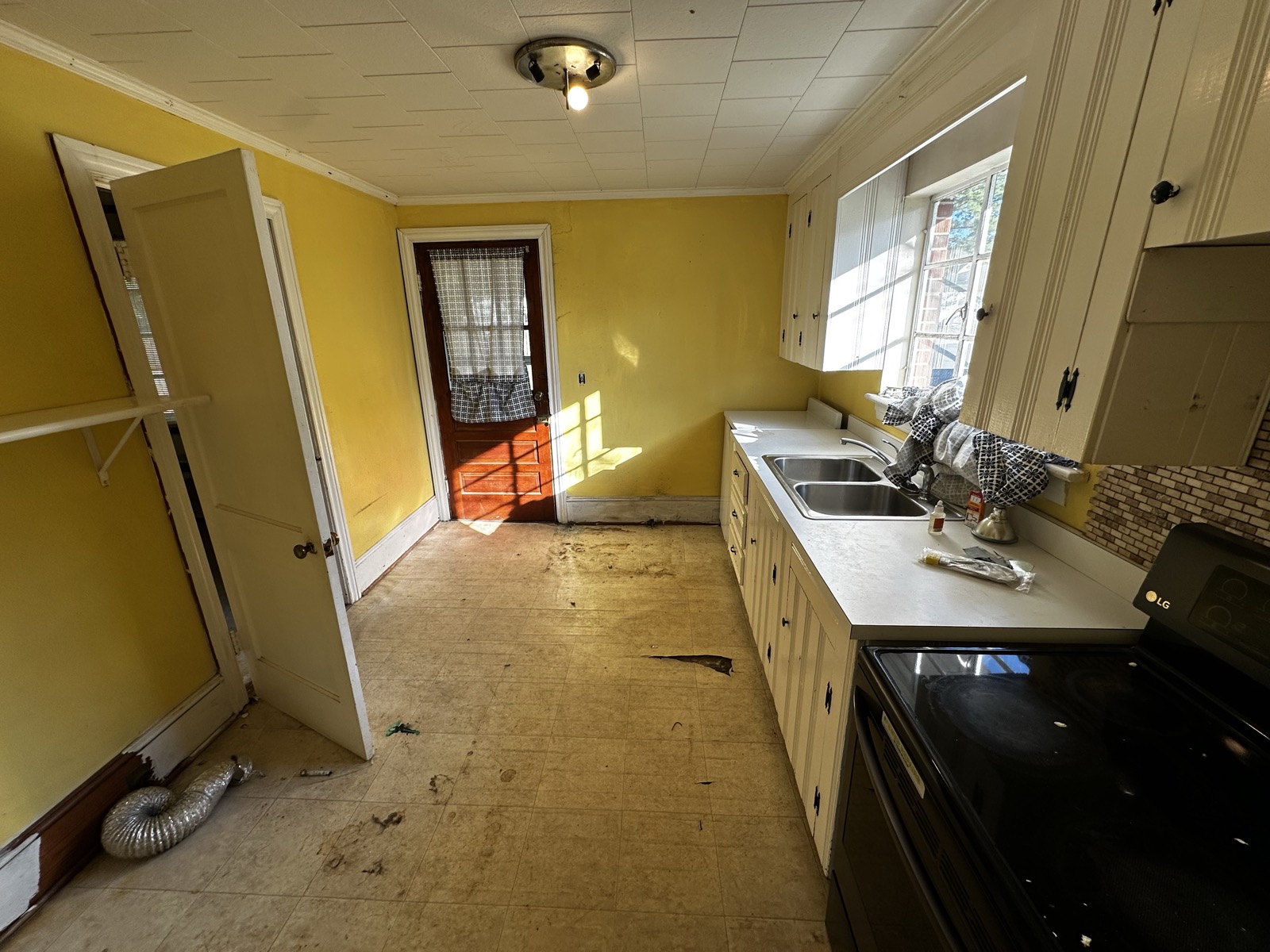
A kitchen in a house that sat empty, photographed the way we bought it. Small problems compound quietly when nobody is walking through the house each day.
Theft, and specifically metal. Vacant homes get stripped for copper piping, wiring, and the outdoor HVAC condenser. If you've ever wondered why the AC unit disappears from empty houses, that's why. It's usually not a break-in in the dramatic sense either, since a house with dark windows, uncollected mail, and grass to the knee advertises itself.
Squatters. An empty house is an invitation, and getting someone out is a legal process, not a phone call. North Carolina did tighten this up with Senate Bill 55 (Session Law 2025-88), which created an expedited removal path, and we walk through how that actually works in our post on selling a Durham rental with bad tenants or squatters. It's far better to not need it.
Code enforcement. Durham's Neighborhood Improvement Services handles overgrowth, debris, and Minimum Housing Code issues, and vacant properties draw complaints because neighbors notice them first. A tall-grass citation is a nuisance. A Minimum Housing Code case on a deteriorating vacant structure is a genuine problem that follows the property, and our post on selling a Durham house with code violations covers what that involves.
The reason to lay all of this out plainly isn't to alarm you. It's that these compound. Deferred water damage invites mold, an unsecured house invites theft, a stripped house draws a code case, and each one narrows what you can do with the property later.
What a Vacant Durham House Costs Every Month
Owners consistently underestimate this, because the costs arrive in small separate pieces rather than one bill. Here's the realistic monthly picture on a typical Durham home.
Mortgage and escrow, if there's still a loan: commonly $1,200 to $2,500
Property taxes (Durham County plus city rates are among the higher combined rates in the Triangle): roughly $250 to $400 per month equivalent on a mid-range home
Insurance: $100 to $250 now, and meaningfully more once you switch to a proper vacant-property policy
Utilities you can't actually shut off: $75 to $200. You need heat in winter to protect the pipes and some airflow in a Durham summer to keep humidity from becoming a mold problem.
Lawn and exterior upkeep: $120 to $250, and this one isn't optional once code enforcement is in the picture
Someone checking on it: free if a neighbor or family member does it, real money if they don't
Even with no mortgage, you're often looking at $550 to $1,100 a month to own a house nobody lives in. With a mortgage, $1,750 to $3,600. Spread that across the eighteen months these situations commonly run and the number gets uncomfortable, which is exactly why the insurance question above matters so much: paying all of that and still being uninsured is the worst of both worlds.
Your Three Real Options
When a house is sitting empty, the choices come down to three. Here's what each actually involves.
Option 1: Clean It Out, Fix It Up, and List It
If the house is structurally sound, you've got real time, and you can manage the work, listing it on the open market can net the most. That's a legitimate path. But it's worth seeing the actual sequence, because "clean it out and list it" compresses a lot into six words. Here's what it looks like week by week.
Weeks one and two are the cleanout, and this is the step people underestimate most. A house that's been closed up with a lifetime of belongings in it runs $1,200 to $3,500 for a professional cleanout, more if there's a basement or outbuildings. If you're doing it yourself and you live out of state, that's flights, a rental van, and vacation days, plus the emotional weight of sorting a parent's belongings if that's the situation you're in.
Weeks three through six are the repairs you discover once the house is empty and you can finally see the floors and walls. This is where vacant houses differ from occupied ones: the damage was invisible until now. Water staining behind where the couch was. A soft spot in the hallway. An HVAC system that hasn't run in a year and needs $600 to restart or $6,000 to replace. Budget $4,000 to $15,000 for a house that's been empty a while, and understand you're bidding this work from another city if you've moved.
Weeks seven through ten are prep and listing: paint, cleaning, sometimes staging, since an empty house shows poorly and photographs worse. Then 30 to 60 days on market in a normal Durham market, then another 30 to 45 for the buyer's financing and appraisal, and a financed buyer's lender may balk at deferred maintenance and send you back to make repairs mid-deal. Each step depends on the one before it landing on schedule, and a delay in week four pushes everything behind it. Meanwhile the carrying costs above keep running every single month, and you're coordinating contractors you can't meet in person while the house sits empty and exposed.
Plenty of owners we eventually work with tried this route for four or five months first. The most common thing they say when they call is that the cleanout alone took three weekends they didn't have, and they wish they'd known at the start how much of the year it was going to eat.
Option 2: Rent It Out
Renting solves the vacancy problem by definition, and if you want to be a landlord it can work. Understand what you're signing up for. The house has to be made rent-ready first, which means the same repairs the listing path requires, often $3,000 to $10,000 on a home that's been sitting. Then it's tenant screening, a lease, and either managing it yourself or paying 8 to 10 percent of rent to a property manager. Durham's rental demand is genuinely strong, which helps. But you've converted a vacant-house problem into a landlord job, and if you took it on mainly to stop the bleeding rather than because you wanted rental income, that job tends to wear thin. It's also a longer commitment than it looks, since selling later means either waiting out a lease or selling with a tenant in place.
Option 3: Sell It As-Is
The third path is selling the house exactly as it stands, belongings included, no cleanout, no repairs. What you're trading is top-line price. What you get is the meter stopping. There's no cleanout to fund or fly in for, no contractor coordination from another state, no staging an empty house, no 30-to-60 day listing window with the property still exposed, and no financed buyer whose lender balks at the condition. A cash purchase can close in a week or two, and the insurance, tax, utility, and upkeep costs stop on the closing date.
It isn't right for everyone. If the house is in good shape and you have the time and bandwidth, list it. But when the property is several states away, or full of a lifetime of belongings, or has been empty long enough that you're honestly not sure what you'd find inside, an as-is sale exists for exactly that.
What Selling a Vacant House As-Is Actually Looks Like
Here's how it works with us, so nothing is a surprise. We've been buying houses across Durham and the Triangle since 2018, and vacant homes are a large share of what we buy.
You don't clean anything out. Furniture, clothes, boxes in the attic, the garage nobody's opened. Take what matters to you and leave the rest. We handle disposal.
No repairs, no utilities required. We don't need the power on to look at it, and we're not asking you to fix the roof or the HVAC first. We buy houses with water damage, mold, and open code cases.
You don't need to be here. Most vacant-house sellers we work with live somewhere else. We can access the property with a lockbox or a neighbor, and closing happens by mail with a notary wherever you are.
You get a same-day cash offer. One number, no obligation, no commission, and we cover the standard closing costs.
You pick the closing date. Fast if you want the carrying costs to stop, or a few weeks out if you need time to get belongings or paperwork sorted.
Does my homeowners insurance still cover my house if it's vacant?
Often not, and this catches most owners off guard. Standard homeowners policies contain a vacancy clause, and once a home has been vacant for a set period, commonly 30 to 60 consecutive days depending on the carrier, coverage for vandalism, theft, glass breakage, and frequently water damage can be reduced or denied. Those are the exact losses vacant homes suffer. Call your carrier, ask what your policy's vacancy threshold is and whether you've crossed it, and get the answer in writing. If you're keeping the house, you likely need a vacant property or unoccupied-dwelling policy, which costs more but actually covers you.
How long can a house sit vacant in Durham before it becomes a problem?
Sooner than most people expect. The insurance vacancy clause can bite at 30 to 60 days. Undetected water damage and winter freeze risk build over a single season. Theft of copper and HVAC equipment tends to follow visible signs of vacancy like uncollected mail and overgrown grass, which show up within weeks. Durham's Neighborhood Improvement Services responds to neighbor complaints about overgrowth and debris, and those complaints usually come early. The first 60 days are mostly about insurance and securing the property; after about six months you're accumulating condition problems that affect what the house is worth.
Do I have to clean out the house before I sell it?
Not if you sell as-is to a cash buyer. Take what matters to you and leave everything else, including furniture, clothing, and whatever's in the attic and garage. We handle disposal. This matters more than people realize on vacant houses, because a professional cleanout runs $1,200 to $3,500 and it's the single step that stalls most owners, especially those managing the property from out of state. Selling on the open market is different: there you'd need the house cleaned out and usually cleaned up before it shows.
Can I sell a vacant house I inherited if probate isn't finished?
Often yes. In North Carolina real estate generally vests in the heirs at the moment of death, so a home can frequently be sold while the estate is still open, though the specifics depend on the will, the number of heirs, and whether the personal representative needs the property to satisfy debts. The Durham County Clerk of Superior Court handles the estate side. Our post on selling an inherited house in Durham walks through it, and the practical advice is to talk to us and to the estate's attorney early rather than waiting for probate to close, because the house keeps costing money the entire time.
What if someone is squatting in my vacant Durham house?
Don't try to remove them yourself, and don't change the locks and hope. It's a legal process. North Carolina's Senate Bill 55 (Session Law 2025-88) created an expedited path for removing unauthorized occupants, which is meaningfully faster than the old route. We also buy houses with occupants still in them, so if that's your situation you don't have to resolve it before selling. Tell us what's going on and we'll work with it.
How fast can I sell a vacant house in Durham?
A cash sale can close in as little as one to two weeks, since there's no cleanout, no repairs, no listing period, and no buyer financing that can fall through. Vacant houses are often the fastest closings we do, because there's no one to move out and no showings to coordinate. If the property is out of state or tied to an estate, add a little time for paperwork and mail-away signing. A traditional listing on a vacant home commonly runs three to five months once you count cleanout, repairs, market time, and the buyer's financing.
An empty house feels like something you can deal with later, and that's exactly what makes it expensive: later arrives one quiet month at a time. Whichever direction you go, do the insurance call this week and get the property secured. If you want a straight read on what the house is worth as it sits, belongings and all, reach out and we'll give you a same-day cash offer and an honest answer about whether selling or listing makes more sense for your situation.
AJ (Asad Jamal)
Founder, Atlantis Homebuyers
AJ has been buying houses for cash in Raleigh and Central NC since 2018. He's personally involved in every transaction and can be reached at (984) 205-6984.