How to Sell a Fire-Damaged House in North Carolina
By AJ (Asad Jamal)
A dated kitchen in a North Carolina house we bought as-is. Nothing was fixed or cleaned out first.
A house fire doesn't end when the trucks pull away. That's usually when the hard part starts. There's an adjuster to meet, a claim to document, a mortgage that still comes due on the first, and a house nobody can live in. If you're trying to work out how to sell a fire-damaged house in North Carolina, you're probably somewhere in the middle of all that. And the question underneath everything is pretty simple: do you rebuild this house, or do you let it go?
There's no single right answer. A kitchen fire that was out in ten minutes is a different decision from a house that lost its roof. Below is what matters in North Carolina specifically. The insurance deadlines come first, then your mortgage company's role in the check, what you owe a buyer in disclosure, and what happens if the city gets involved. The last part covers how a sale works if you decide not to rebuild. If you want the short version first, our page on selling a damaged property covers the basics.
Can You Sell a House After a Fire in North Carolina?
Yes. Nothing in North Carolina law says you have to repair a fire-damaged house before you sell it, and nothing says you have to wait for the insurance claim to close. Burned houses sell in every condition, from smoke damage in a single bedroom to a total loss where the lot is most of the value.
The real limit is who can buy. Most people buy homes with a mortgage, and most lenders won't finance a house that isn't livable. A home with a burned-out kitchen, open framing, or no working electrical usually won't qualify for an FHA or conventional loan until it's repaired. That shrinks your buyer pool to people paying cash or using a renovation loan, which is why so many fire-damaged houses end up with cash buyers.
So you can sell. The decision is which way of selling leaves you better off, given how bad the damage is, what the insurance will pay, and how much time and energy you have left for this.
About AJ Jamal, Founder of Atlantis Homebuyers
Watch AJ's take · about 1 minute
Your Insurance Claim: The North Carolina Deadlines That Matter
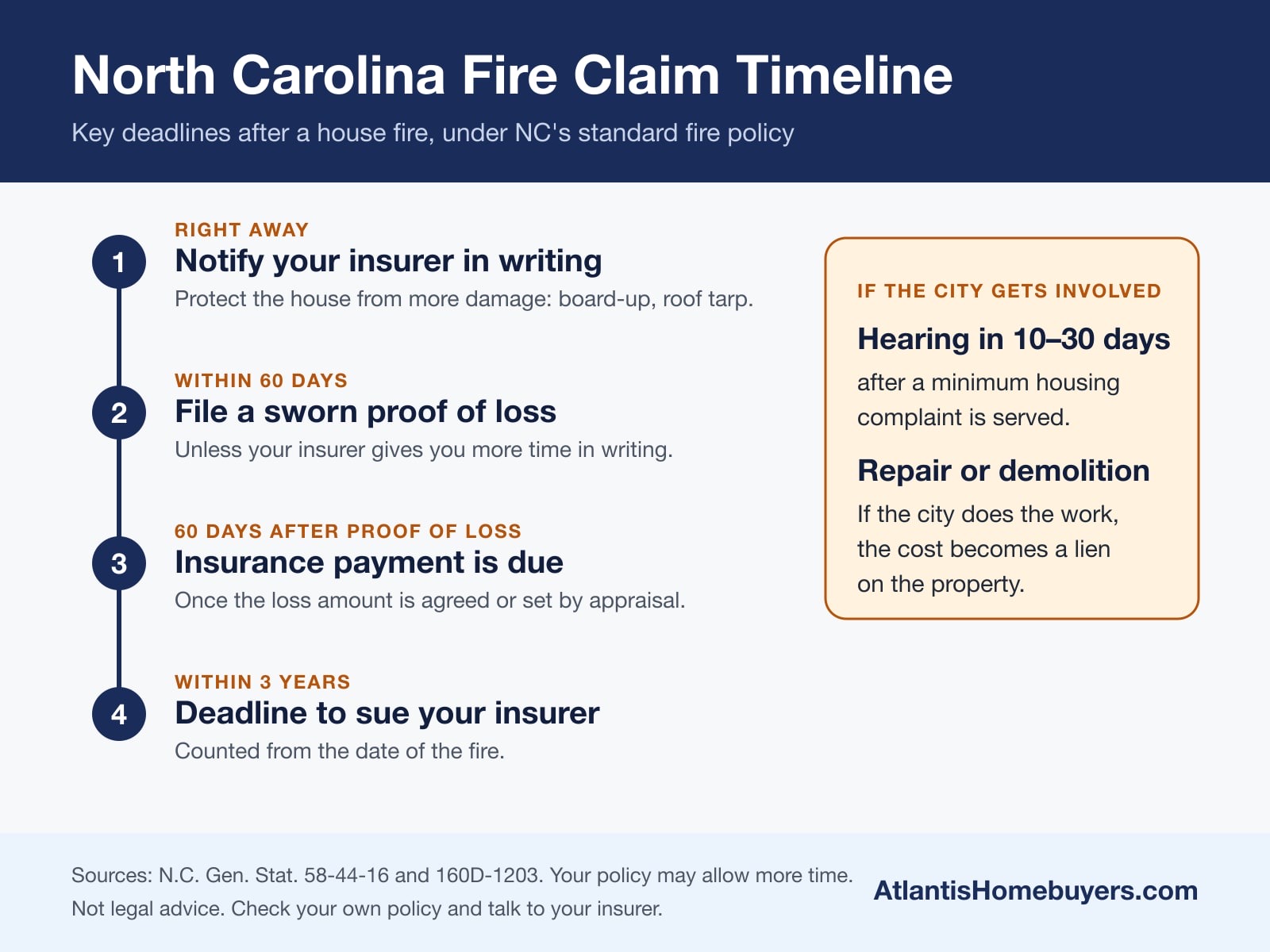
Fire coverage in North Carolina is built on the state's standard fire policy, which is written into law at G.S. 58-44-16. Your own policy can be more generous, but these baseline terms are the ones to know, even if you plan to sell:
Notify the insurer right away, in writing, and protect the house from further damage. That's why the board-up and the tarp on the roof come first.
File a signed, sworn proof of loss within 60 days of the fire, unless the insurer gives you more time in writing.
Payment is due 60 days after the insurer receives your proof of loss and the amount of the loss is agreed or set by appraisal.
You have three years from the fire to sue if the claim turns into a dispute.
Key deadlines under NC's standard fire policy (G.S. 58-44-16) and city minimum housing rules (G.S. 160D-1203).
The 60-day proof of loss is the deadline people miss, especially when they're displaced and running on no sleep. If you need more time, ask the adjuster for an extension and get it in writing.
Also read the additional living expense section of your policy. That's the coverage paying for the hotel or the short-term rental right now, and it has a limit. When it runs out, you're paying rent on top of a mortgage on a house you can't live in, and that changes how long you can afford to wait.
None of this has to be finished before you talk to a buyer. A sale and an open claim can run side by side.
Why Your Mortgage Company Controls the Insurance Check
This is the part that catches most homeowners off guard. If you have a mortgage, your lender is almost certainly listed on the policy, and the insurance check for the house comes made out to you and the lender together. You can't cash it on your own.
Many mortgage servicers then put the money in a holding account and release it in stages as the repairs get done, with an inspection before each payment. If your loan is current, the first release tends to be larger. If you've fallen behind, expect the servicer to hold on tighter and pay out in smaller pieces. The rules depend on who owns your loan (Fannie Mae, Freddie Mac, FHA, VA, or a private lender) and on your servicer. So call and ask. How much will they release up front? What do they need before each payment? And what happens to the money if you sell instead of rebuilding?
That last question matters most if selling is on the table. When the house sells, your mortgage is paid off at closing from the sale. What happens to the insurance money after that depends on what's left on the loan and on what your servicer and policy allow, so get the answer in writing before you sign anything.
Selling Before the Claim Settles: Keep the Money or Pass It On?
You don't have to wait for the claim to close to sell the house. If you sell first, there are usually two ways the insurance money gets handled.
You keep the claim. You sell the house in its damaged condition, the price reflects that condition, and you keep working your claim with the insurer yourself. For most people this is the cleanest setup, because the sale and the claim stay completely separate.
The buyer takes over the proceeds. Some sellers assign the right to the insurance payment to the buyer, and the price goes up to account for it. Whether that's allowed depends on your policy's wording and on your insurer, and insurance policies often include language that limits assigning them. If you go this way, get the insurer's position in writing and have a real estate attorney look at it before closing.
Either way, you don't need this figured out before you get an offer. Tell us where the claim stands and we'll talk through how each option changes the numbers for you.
Do You Have to Disclose Fire Damage When You Sell in NC?
North Carolina requires a Residential Property and Owners' Association Disclosure Statement in most home sales, and it goes to the buyer before they make an offer (G.S. 47E-4). On many of its questions you're allowed to answer "No Representation," which means you aren't making a statement either way.
That box doesn't make a fire go away. Real estate agents in North Carolina have their own duty to tell buyers about material facts they know about, and NC REALTORS has said fire damage stays a material fact even after it's been repaired. A fire is also the kind of thing an inspector finds anyway: new framing in an old attic, fresh drywall in one room, a smell that comes back on a humid day. And actively hiding a problem you know about can lead to a fraud claim no matter what you checked on the form.
The simple version is to be upfront about it. When you sell to a cash buyer who's walking the house as it stands, the fire is where the conversation starts. If you're not sure what you need to disclose in your situation, a real estate attorney can tell you.
When the City Condemns the House or Orders Demolition
After a serious fire, a city or county inspector may post the house as unsafe. Under G.S. 160D-1119, an inspector can condemn a building that's especially dangerous because of its fire risk, damaged walls or floors, or unsafe wiring and heating, and the notice goes right on the building.
A house that sits damaged can also end up in the city's minimum housing process under G.S. 160D-1203. The city serves a complaint and holds a hearing 10 to 30 days later. After that, the owner can be ordered to repair the house, or to close it up, or to tear it down, depending on whether repairs are reasonable compared with what the house is worth. If the owner doesn't act, the city can do the work itself, and what it spends becomes a lien on the property.
That lien has to be paid before the house can sell with clean title, so an order you ignore turns into a bill you pay at closing anyway. If you've received a notice or a hearing date, don't wait it out. Rules and thresholds vary from city to city, so call the inspections office that sent it. Our posts on selling a house with code violations in Raleigh and Durham go deeper on how those cases work. We buy houses with open condemnation and code cases, and the case doesn't have to be closed before we close.
Why Waiting Gets Expensive After a Fire
A fire-damaged house doesn't sit still. Every month it's open to the weather, it gets worse. Rain gets in through a damaged roof, wet insulation and drywall start growing mold, and a house that needed a kitchen rebuild in March needs a kitchen and a subfloor by June.
The money side keeps moving too. The mortgage, the property taxes and the insurance premium all still come due. The living expense coverage has a limit and a clock. A boarded-up house also draws attention: scrappers after the copper, people looking for a place to sleep, and neighbor complaints that can start the city process above. Many insurers limit coverage once a house has been vacant for a set number of days, too, so the house can lose protection right when it's most exposed.
None of that means you have to rush. It means the decision costs something even while you're not making it, and real numbers help. A same-day cash offer gives you one of those numbers without committing you to anything.
Your Three Options for a Fire-Damaged House
Once the fire is out and the claim is open, the choices come down to three.
Option 1: Rebuild With the Insurance Money, Then List It
If your policy limits are solid, the damage is contained, and you have time, rebuilding and selling at full price can net the most. It's a real path. The conventional path looks clean on paper, though. Here's what it actually looks like week by week.
Weeks one through four are the claim. Board-up and a roof tarp, the adjuster's visit, a room-by-room contents inventory, and a proof of loss due by day 60. Emergency board-up and mitigation commonly run $1,500 to $5,000 before anything gets rebuilt. You're collecting contractor estimates at the same time, because the adjuster's number and the contractors' numbers rarely match, and closing that gap is a negotiation you run yourself.
Weeks five through twelve are the money and the permits. Your servicer releases the first payment, you hire a contractor (good restoration crews stay booked), and the city wants a building permit before any structural or electrical work starts. Smoke damage that looks cosmetic often isn't. Soot works its way into ductwork, insulation and framing, and a whole-house smoke cleanup can run $10,000 to $30,000 on its own.
Months four through eight are the rebuild. A kitchen fire that spread into the ceiling commonly turns into $40,000 to $90,000 of work once you count demolition, framing, electrical, drywall, cabinets and finishes. Every phase waits on a city inspection and on the next payment from your servicer, so one slow inspection or one slow draw stops the whole job. Then comes the listing: 30 to 60 days on the market, plus another 30 to 45 for the buyer's financing and appraisal, with the fire on the disclosure form the whole way.
That's eight months to a year from the fire, if every step lands on schedule, and every step depends on the one before it. All of it happens while you're paying a mortgage on a house you can't live in, plus rent once the living expense coverage runs out, and while you're still dealing with what you lost. Most of the owners who call us after starting down this road say the same thing: they didn't expect the rebuild to take over their whole year.
Option 2: List It As-Is on the Open Market
You can put a fire-damaged house on the MLS without fixing it. An agent lists it as-is, priced for its condition, and you take offers. The catch is the buyer pool. Most MLS shoppers use a mortgage, and their lenders won't finance a house that isn't livable, so your real buyers are cash investors who happen to be browsing the MLS. You'll still pay a listing commission, sit through showings in a damaged house, and deal with inspection and appraisal contingencies that can reopen the price after you're under contract. It can work, especially for light smoke damage in a strong neighborhood. With heavier damage, it often drags on longer than people expect.
Option 3: Sell It As-Is for Cash
The third path is selling the house exactly as it stands: soot, smell, boarded windows and all. You don't rebuild, you don't clean up, and you don't wait on draws or inspectors. What you give up is the top-line price a fully rebuilt house would bring. What you get is a closing date, often within a couple of weeks, and an end to the mortgage payments, the taxes, the insurance, and the worry about what's happening to the house while it sits.
It isn't the right call for everyone. If your coverage is strong, you have somewhere stable to live, and you actually want to rebuild, rebuild. It can come out ahead, and if that's what your numbers say, we'll tell you so. But if the claim is dragging, the living expense money is running low, or you can't face a year of contractors, an as-is sale exists for exactly that situation.
What Selling a Fire-Damaged House As-Is Looks Like With Us
Here's how it works, so there are no surprises later. We're a family-owned company run by AJ and Isabel Jamal, buying houses across North Carolina since 2018. We're BBB Accredited, our Google reviews are 5 stars, and you may have seen us on local Raleigh morning TV. We buy fire-damaged houses all over the state, from as-is homes in Raleigh and Durham to Fayetteville and the Triad.
No repairs and no cleanup. Leave the damaged contents, the debris and the smell. Take what matters to you and we'll handle the rest.
Your claim can still be open. Tell us where it stands and we'll work around it.
A same-day cash offer. One number, no obligation, no commission, and we cover the standard closing costs.
Your mortgage is paid off at closing. The closing attorney orders the payoff and settles it from the sale, along with any city lien.
You pick the closing date. A week or two out if you want the costs to stop, or later if you need time to sort out the claim or find a place to live.
You don't need to be at the house. If you're staying with family across the state, we can handle access and close by mail with a notary.
Our how it works page walks through the whole process, or you can tell us what happened and go from there. You don't need the claim settled or the paperwork organized before you call.
Frequently Asked Questions About Selling a Fire-Damaged House
Can I sell my house after a fire in North Carolina?
Yes. North Carolina doesn't require you to repair fire damage or finish your insurance claim before you sell. The practical limit is financing: most mortgage lenders won't lend on a house that isn't livable, so fire-damaged homes usually sell to cash buyers or to buyers using renovation loans. You can sell with the house as it stands and the claim still open.
Do I have to disclose fire damage when selling a house in NC?
Plan on it. North Carolina's disclosure statement lets you answer "No Representation" on many items, but real estate agents still have to disclose material facts they know about, and NC REALTORS treats fire damage as material even after repairs. Hiding a problem you know about can also lead to a fraud claim. Being upfront is the safer path, and a cash buyer who walks the house as it stands already knows what happened. A real estate attorney can advise on your specific situation.
Who gets the insurance money if I sell my fire-damaged house?
It depends on how the sale is set up. Most often you keep the claim, sell the house in its current condition, and collect the insurance yourself. Some sellers instead assign the insurance proceeds to the buyer for a higher price, but that depends on your policy's wording and your insurer. If you have a mortgage, your lender is named on the check and has a say until the loan is paid off. Get your servicer's and insurer's answers in writing before you sign.
Can I sell my house before the insurance claim is settled?
Yes. A sale and an open claim can run at the same time. Under North Carolina's standard fire policy terms you still owe the insurer a sworn proof of loss within 60 days of the fire unless they extend it in writing, so keep the claim moving while you look at offers. Most sellers keep the claim and sell the house as-is, which keeps the two separate.
What is a fire-damaged house worth?
It depends on how much of the house was damaged and what similar houses in the neighborhood sell for. A house with smoke damage in one room is priced very differently from a total loss where the value is mostly the lot. The quickest way to a real number is to ask. We can give you a same-day cash offer on the house as it sits, with no obligation, so you can compare it with your insurance payout and your rebuild estimate.
How fast can I sell a fire-damaged house in North Carolina?
A cash sale can close in as little as one to two weeks, because there are no repairs, no listing period and no lender appraisal to wait on. If there's a mortgage payoff, a city lien or an estate involved, allow a little more time for the closing attorney to settle the payoffs. Rebuilding and then listing on the open market commonly takes eight months to a year from the date of the fire.
A fire takes a lot from you in one night, and then it hands you a dozen decisions while you're still getting your feet back under you. You don't have to make all of them this week. Get the board-up done, keep the claim moving, and find out what your options are worth. If you want a straight answer on what the house is worth as it stands, reach out and we'll give you a same-day cash offer, along with an honest read on whether selling or rebuilding makes more sense for you.
AJ (Asad Jamal)
Founder, Atlantis Homebuyers
AJ has been buying houses for cash in Raleigh and Central NC since 2018. He's personally involved in every transaction and can be reached at (984) 205-6984.